.png&w=256&q=75)
Access to information at speed and in real time is undergoing its own Moore's law, albeit with timelines much divorced from its nanoscale rival in the technology space. Enterprises today increasingly rely on rapid access to trusted information to drive decision making, operational efficiency and innovation.
Information today requires both categorization and ingestion for neural networks powering AI algorithms across data at rest and data in motion. This raises an important question:
How do we define the right Information Architecture?
A well-designed Information Architecture enables enterprises to transform fragmented data into actionable intelligence, creating a foundation for analytics, automation, AI adoption and strategic decision making.
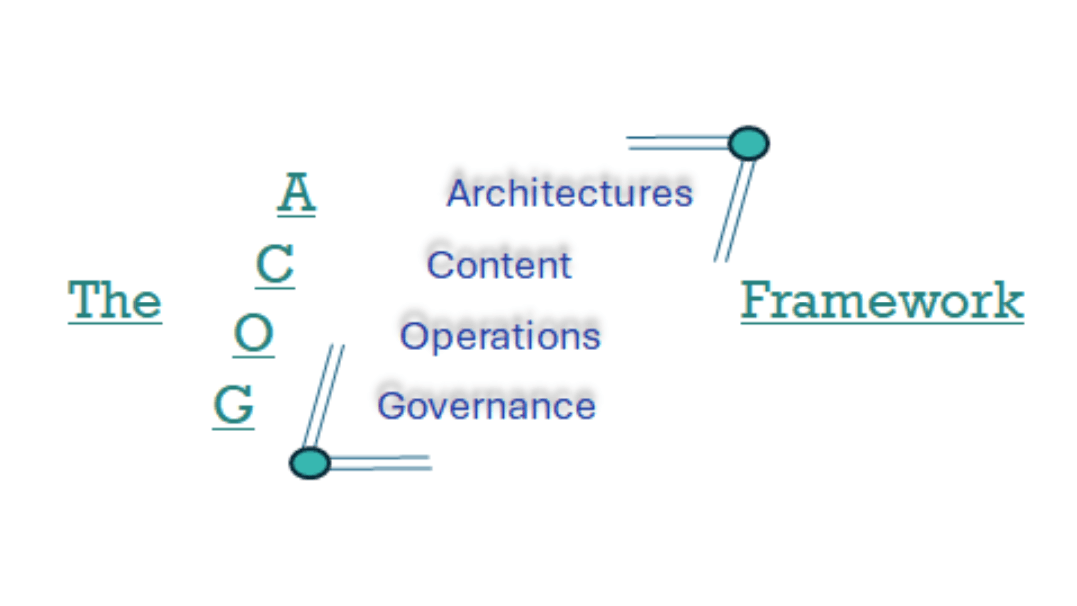
Ribionic's ACOG Framework
At Ribionic, we use our ACOG framework which helps businesses understand and plan better to achieve desired outcomes in synchronization with their business needs.
It unclogs an organization's mental and structural frameworks with actionable insights. The framework follows a comprehensive approach taking data from across the organization covering:
- Vision
- Market / Maturity
- Domain
- Organization / Operations
- Strategies
- People
Together these dimensions form what we call the ViMDOSP Approach.
Information Architecture as an Enterprise Blueprint
To process data into information and provide the blueprint for an enterprise approach to designing, implementing and managing information requires an adaptive organization that evolves along its digital maturity journey.
In our observations, successful outcomes often follow Conway's Law, where aligned and streamlined organizational structures lead to more effective technology and information systems.
An Information Architecture defines the context an enterprise uses for business operations, management, analytics and strategic decision making.
Core Building Blocks
The building blocks of an effective Information Architecture encompass both technology and organizational capabilities.
- Enterprise applications
- Business processes
- Analytics platforms
- Reporting systems
- Aligned workforce generating and maintaining business content and data
Enterprise applications consume and leverage these information architecture models, which are themselves built upon a robust data architecture responsible for collecting, storing, moving, integrating and managing enterprise data.
A best-in-class Information Architecture implements Data Governance, supported by Master Process Management and Master Data Management initiatives to ensure consistency, trust and business alignment.
The models developed by Ribionic and its team of experts help organizations deliver on these seemingly challenging goals, creating a scalable information foundation ready for advanced analytics, AI adoption and future digital transformation initiatives.
For queries, please reach out to us atinfo@ribionic.com